
Have you ever wondered if data visualization can help you improve your website performance?!
As a webmaster, you must be dealing with a lot of confusing numbers and information. And analyzing numbers is not the easiest task in the world; we can relate! That’s where data visualization comes in as a simple way to understand complex and traditional forms of data.
Now, you’re probably wondering ‘What is data visualization, and why is it important?’ Well, it refers to presenting information and data in a visual format that every user can easily see and understand. In fact, visualizing data in different forms plays an important role in quickly getting an overview of information.
Now, if you are looking for a CRO tool that can help you understand your data quickly with heatmaps, then you are in the right place! WatchThemLive will help you track visitor behavior and visually represent your data through graphs, heatmaps, and more.
Here, in this article, we will answer all your questions about data visualization. Now, get out your pen and paper, and let’s get started, Shall we?!
What Is Data Visualization Definition
While the term sounds scary, it means understanding information much easier. Generally speaking, it is a visual representation of data and information in a way that makes more sense, even to non-technical audiences.
That is, with visual elements like maps, graphs, charts, and heatmap tools, data visualization paves the path to understanding trends and patterns. So, instead of presenting information in complex written text, you can see an image that illustrates everything in a simpler way. Because human beings are visual learners, visualizing data in any form makes more sense than written text.
Now, let’s jump into the reason why it is important.
Why Is Data Visualization Important
Visual representation of data is considered essential for any individual, from teachers to managers and employers.
However, data visualization also plays an important role in projects with a large scale of data. Since all businesses deal with a lot of data and information, they need a method to categorize them well and present the results in an understandable way. And, the human brain can understand visualized data like charts and graphs better than complex spreadsheets!
In general, since data visualization enables you to create an image that will illustrate the information in a more straightforward way, it’s a quicker process to help businesses convey complex concepts and make data more memorable.
Moreover, visualized data in behavioral analytics tools can help you identify factors that affect your customers’ behavior, figure out the areas that need improvement, find the areas to place specific products, and more.
Now, let’s delve deeper into the benefits of data visualization for businesses:
- First, it can compile all information into one place and make the data easy to digest,
- Second, it enables you to take in a large volume of data in a blink of an eye,
- Third, it makes the decision-making process faster since the viewers gain better insights into trends,
- Fourth, it can increase the viewers’ engagement because they can understand the data,
- Fifth, Data visualization enables you to get in-depth insights into patterns, trends, and areas that need more attention,
- Last but not least, it can clarify which factors affect your customers’ behaviors.
Now, let’s dive into the ways that data visualization can be used, shall we?!
How to Use Data Visualization
In today’s world, all types of businesses of all sizes are using visualized data to help make sense of their information. With a visual representation of data, business owners can have an overview of large amounts of information at a glance and draw a conclusion from them.
In addition, as it is easier and faster to analyze graphical data (rather than pouring information into spreadsheets), business owners can notice the problems and find the answers faster.
Well, we’ve covered what data visualization means. Now, let’s get a little bit deeper and explore its use cases briefly.
#1 Identify Trends And Spikes
One of the essential tasks in marketing is to identify data trends. A simple use case of data visualization is comparing your website traffic in 2 months. For example, If you notice a spike in your page views compared to the previous month, you will conclude that new blog posts drive significant traffic!
#2 Monitoring Your Desired Goals And Results
The second use case of data visualization is monitoring your business progress toward one or more of your desired goals. For instance, monitoring your sales performance versus goals for revenue gives instant insight into the overall sales performance and helps identify specific actions to achieve goals.
#3 Gathering Diverse Data Sets
Want to evaluate your marketing channels?! Data visualization aggregates data from different parameters and creates visual displays to compare results over the same time period. For example, you can compare page views of different channels in a display and look at the overall effectiveness of each channel in the last month.
All right, now it’s time to touch on some of the most popular types of data visualization.
Different Types of Data Visualization
In its primary forms, the simplest method was to put information in an Excel sheet converted into bar charts and other tables. Although this method is still effective and widely used, the process has become advanced in recent years. So, when choosing a data visualization type, you can get more specific with your needs.
In the following, you’re about to see some data visualization examples.
1. Chart
It is a popular type of data visualization which is presented in graphical form and displays data along two axes. To clarify, using charts will help you make predictions about existing and future data based on the present pattern.
2. Table
Another type of data visualization is by the means of tables. They contain numerical data placed in rows and columns based on a certain order.
3. Graph
It mainly focuses on raw data and depicts the trend over time. It will allow users to represent the value in the data through a visual representation. To sum up, a graph is a diagram of lines, curves, segments, and points that visualize data.
4. Geospatial
It describes data by using different colors and shapes on a map. To be accurate, it can represent the relationship between data and its location on the map.
5. Infographics
Another type is infographics. They rely on the text a bit more than the standard data visualization. It usually uses charts and diagrams.
6. Dashboards
A dashboard is the collection of multiple data visualizations in one place. Besides, they can empower audiences with data-informed insights.
Data Visualization Techniques
To better understand, here is an overview of each data visualization technique.
Heatmaps
You’re probably wondering, ‘Why don’t our visitors always do what we expect them to?’ To answer this question, firstly, you must check the retention rate and conversions of your web pages, and then follow the interactions of your visitors on the specific page by using a heat map.
Then, in this way, you will find out which part of your webpage gets the most clicks and which part is more important for visitors.
Heatmap tools show the relationship between two items and provide grading information, including high to low. This grading information is displayed using different colors and saturation.
To sum it up, using heatmaps, you can answer the following questions:
- Which part of your webpage is the most engaging for users?
- In which parts of the site do the visitors scroll without stopping?
- Which parts of the web page are more clickable?
- And finally, at what stage do the visitors usually leave the page?
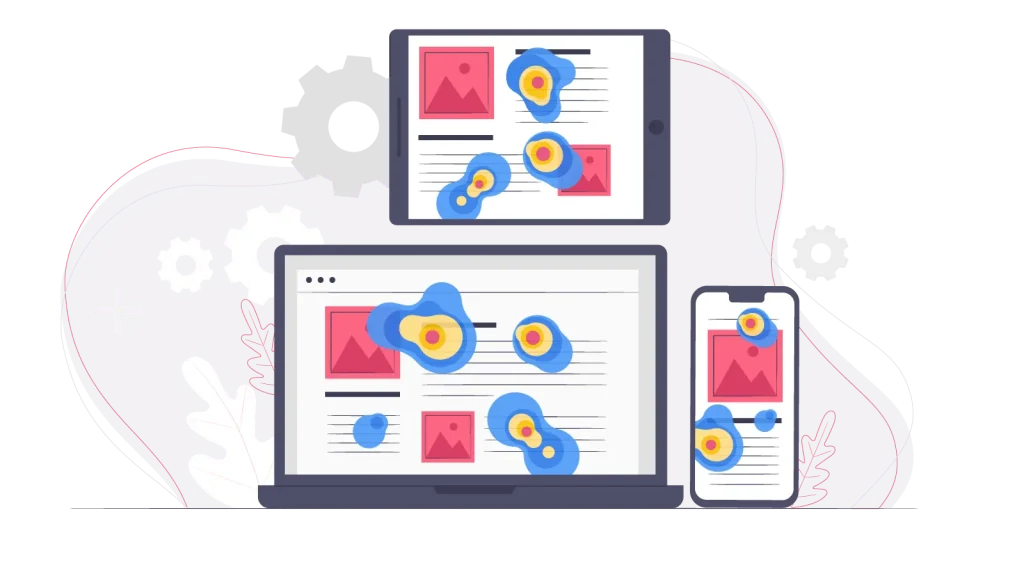
It is one of the unique data visualization techniques that enables you to find areas on your website where your visitors click, scroll or even move their mouse mostly. But, what is it good for? In fact, using this type of data visualization, you will be able to discover the spots on your website that need to be improved in content, CTAs, and more.
If you are looking for the best data visualization tool that offers quick visual cues about your visitors’ behaviors, sign up on WatchThemLive.
Pie Charts
Equally important, a pie chart indicates how the categories represent part of a whole data set using proportional segments divided in a circle. Pie charts represent numbers as percentages, and the total of the segments equals %100.

Area Maps
It is a type of geospatial data visualization that is used to represent specific values set over a map of the country or other geographic location. For example, It can display your visitors’ location, and show you where most of your visitors are from.
Scatter Plots
The scatterplot is a diagram that shows you the relationship between two different variables and indicates the distribution trend. You use it when there are various data points, or you want to highlight similarities in the data set. As one of the data visualization techniques, it is helpful for understanding your data distribution.

Bar Charts
A bar chart is used to show comparisons between different items, or it can show comparisons of items over time. Besides, you can use this data visualization method to see the traffic rate of each landing page or the number of visitors in a period of time.

Funnel Charts
This type of chart shows a set of stages and the completion rate of each stage. Moreover, funnel charts can be used to track sales trends or conversion rates across a series of pages or stages. The CRO tools usually use this type of chart to show your conversions at each stage of the customer journey.

Now, let’s talk about reliable data visualization software.
The Best Website Data Visualization Tool
Looking for a tool to help you get your analytics data more quickly and effectively with graphs, charts, heatmaps, or other visualized data?! In the following, we recommend the best behavioral analytics tool for your website analytics and visitors’ behavioral segmentation in visual formats.
WatchThemLive: The Best Analytics Tool for Visualizing Data
WatchThemLive is a behavioral analytics tool that promises to help you understand your complex data with data visualization. Above all, using WatchThemLive, there is no need to use data visualization platforms, insert your data into them, or create charts or graphs for better interpretation.
What else do you want?! Sign up now and analyze your website analytics data in the simplest way!
Want to know how?!
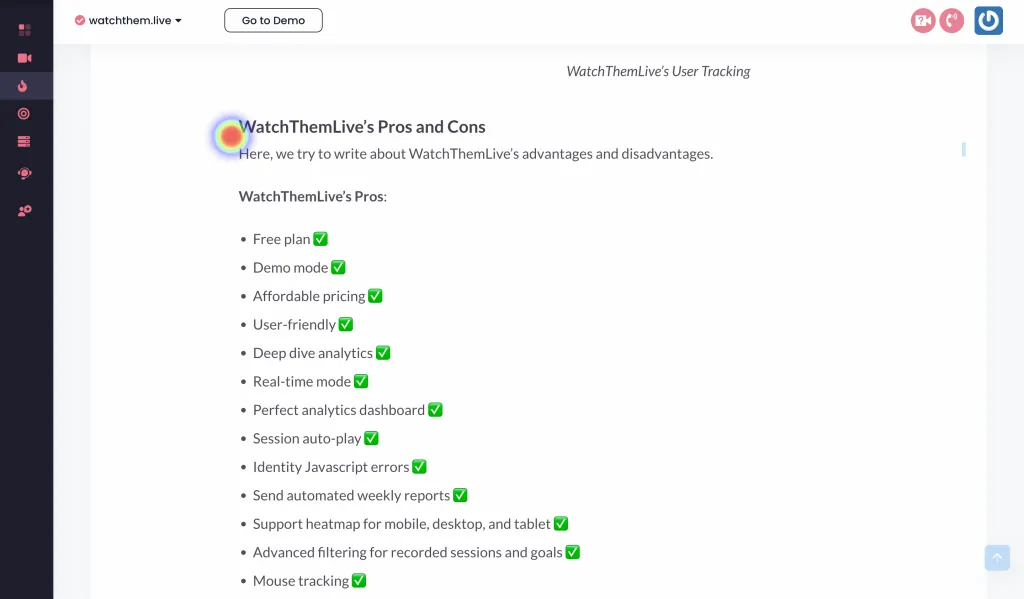
Heatmaps
Want to identify what your visitors care about, expect, and how they interact on your website by visualizing data like clicks? WatchThemLive’s heatmaps will give you a collection of visitors’ engagement across your site. Moreover, with this specific feature, you can quickly see things like the areas that your visitors most liked or what they expected to be clickable.
Pretty straightforward, right?! So, sign up on WatchThemLive now and visualize your visitors’ behavior!
Now, let’s take a look at WatchThemLive’s other features:
WatchThemLive’s Other Features
Website analytics: It provides all the necessary information about your visitors’ journey, like their location, browser, language, country, and more.
Session replays: This feature allows you to record and watch your visitors’ interactions on your website. Awesome, right?!
Goal tracking: With this feature, you can easily track your visitors’ conversion paths by setting up custom events. That is to say, all of the data on WatchThemLive is exportable to CSV and PDF.
Live chat: You can access a visitor’s session after s/he sent a message on the chatbox.
Video testimonials: Want to get testimonial videos from your satisfied clients?! Well, to clarify, this feature enables you to make this process easier. It displays preset questions on the screen; all they need to do is answer them!
Funnel Analysis: With this unique feature, you can trace your visitors’ journey in a customized funnel, and optimize them. Then, it will give you a report of each stage on the funnel.
What are you waiting for?! Sign up now and get immediate access!
FAQs on Data Visualization
The following questions are frequently asked about visualizing data.
1. What Are the Main Goals of Data Visualization?
The purpose of visualizing data in quantitative or qualitative data analysis is not to summarize data in the form of several graphs or images. Actually, the main goal of data visualization is to visualize the data in an effective way that leads to better decision-making.
Therefore, if visualizing data is done effectively, the users will explore data, monitor them, and eventually explain the problem and the reasons behind them.
2. What Is Visualization in Simple Words?
Data visualization refers to the process of interpreting all complex data and information in visual terms like graphs, images, charts, etc.
3. What Are the Characteristics of Good Data Visualization?
Here is a guideline to get familiar with the features of standard visualized data:
- It should be clear:
Data visualization must be easy to understand and give the viewer the possibility of comparison.
- The visual representation of data should be accurate:
In other words, it should summarize a large amount of data in sync with the statistics and descriptions of numerical indicators.
- Good data visualization must be purposeful and reasonable:
It should include a description and appropriate visual effects.
- The visualization should be empowering:
Data visualization should empower the viewers and enable them to understand what action to take after it.
Conclusion
In short, regardless of your profession, data visualization has the ability to help by presenting data as efficiently and effectively as possible. Visualizing data allows you to easily interpret a wide range of complex information and data rather than any other written text.
Data visualization is also useful in website analysis. For example, a heatmap gives you visual cues about your visitors’ behaviors and website performance. In other words, It will help you to identify the best and the worst-performing sections on your site. This visual representation of data enables you to optimize your website.
So, if you’ve decided you want a full analysis of your website analytics and your visitors’ behavior in visual formats, sign up now on WatchThemLive and take full advantage of its impressive features!
Author: Najmieh Sarmadi